
A sick vine rarely looks sick at the most pivotal moment: by the time a grower notices obvious leaf damage while walking the rows, a disease or pest problem may already have spread through part of the vineyard. DeepVisions thinks AI can drastically narrow that gap by examining drone or smartphone photos and directing growers to the spots that need attention first.
We met the Korean startup who pitched their VisionPlus system which is designed to turn field imagery into a map of possible plant-health risks. DeepVisions says growers can upload photos captured by commercial drones or smartphones; its cloud software analyzes the images, flags potential disease or pest indicators, and ties those alerts to GPS locations. The point is not to replace an agronomist’s judgment, but to make the inspection process faster, more thorough and more targeted.
Vineyards are an obvious first use case. Grapes are high-value crops, disease can move quickly, and manually checking every vine is time-consuming. In Seoul, I spoke with Sang-hyun Park, DeepVisions’ CIO, in person. After the company’s presentation, the most revealing detail was the logistics. The technology still depends on someone (or something) getting usable images from the field.
For farmers who already own and operate drones, that may be straightforward. For those who do not, DeepVisions may need a service-provider, rental, or reseller model. Park described discussions with a drone company in Africa whose equipment is already rented to farmers for pesticide spraying. Adding crop analysis to that workflow could make deployment easier, but it also illustrates the central business challenge: AI can analyze an image only after a customer has an affordable, reliable way to capture it.
DeepVisions calls VisionPlus hardware-agnostic, meaning it does not require its own proprietary drone or camera. Its presentation says the system preprocesses field imagery to handle uneven lighting and shadows, then uses deep-learning models to identify potential issues at the vine, leaf, and grape-cluster level. The company also says it uses synthetic data, or AI-generated training examples, to supplement real-world photos when examples of a particular crop disease are limited.
That last point is leading-edge but it should be treated cautiously: synthetic images can help train a system faster, especially when an emerging disease has few labeled examples. But it only works if tests against real vineyards confirm the results.
DeepVisions says it has deployed VisionPlus with a commercial winery in Sapporo, Japan, in connection with NAVER, and has used smartphones to assess grapes through a KOICA project in Vietnam. These early deployments are encouraging, but the road to worldwide success remains long.
DeepVisions’ materials cite expected reductions in pesticide use and improvements in yield, and if that’s true, there’s a strong incentive for farmers to consider this solution. If not, too many false alerts would waste time and erode a grower’s trust. Missed disease would set back the business thesis.
The company is entering a field with capable competitors. Taranis uses drones, aircraft, and satellite data to provide crop intelligence, while Bloomfield Robotics uses vehicle-mounted cameras to collect continuous, plant-level imagery. DeepVisions’ potential advantage is flexibility: it aims to work with equipment farmers or partners may already have, rather than requiring a dedicated imaging system. But flexibility, but not a moat.

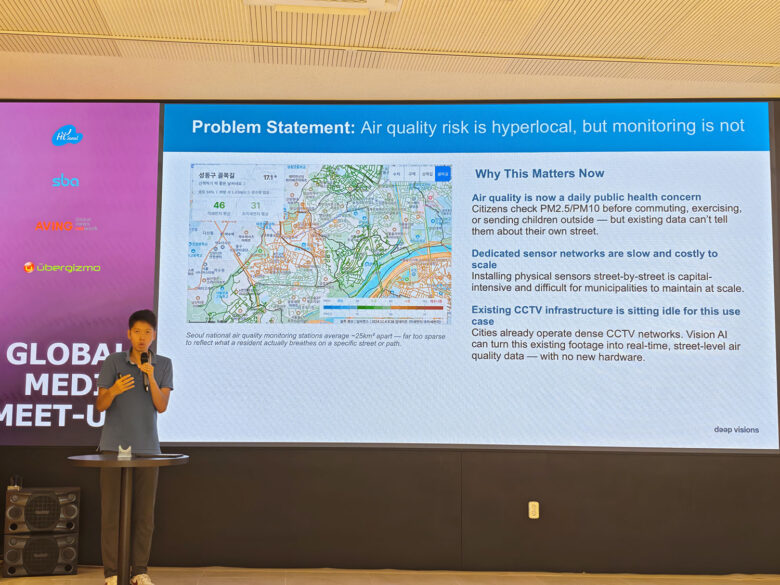
DeepVisions is also pursuing a separate air-quality application. The company says it can infer localized PM10 and PM2.5 levels from CCTV footage by analyzing visual effects such as atmospheric scattering and blur (funny enough, I studied these for videogames 3D rendering).
That is an intriguing idea because air pollution can vary substantially from one neighborhood or street to another. EPA treats fine-particle pollution as a serious public-health issue and maintains a monitoring system based on measured, quality-assured data.
DeepVisions’ Vision Plus did receive outside recognition: it won a Bronze Edison Award in 2026 in the Energy-Optimized Environments category.
DeepVisions says it is exploring Napa Valley as its next vineyard opportunity. For now, that is a planned proof of concept, not a signed U.S. customer. I hope it happens, as it was right next to San Francisco, where I lived for many years.
DeepVisions Uses AI to Spot Vineyard Disease Earlier
, original content from Ubergizmo. Read our Copyrights and terms of use.