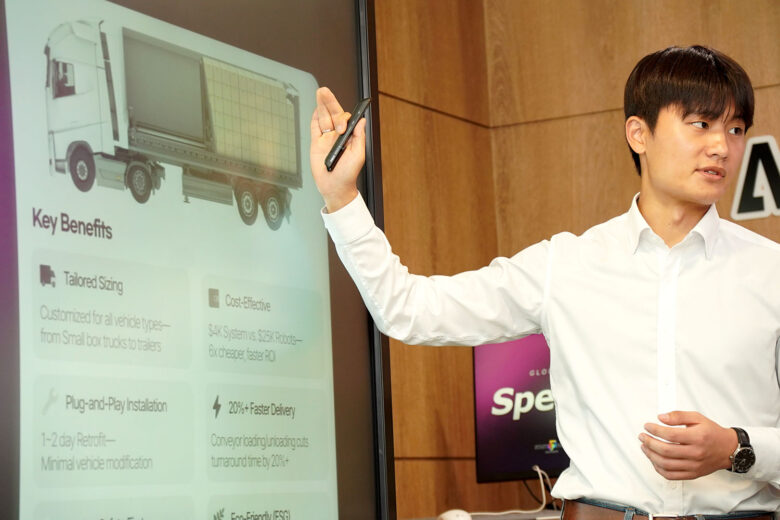

Warehouse automation has become easy to picture: robots move shelves, conveyors route boxes, and software coordinates orders. The less obvious problem is what happens when all that freight reaches a truck. Even in a sophisticated facility, workers may still need to climb into a trailer, stack boxes, push pallets, and wait for the vehicle to be ready.
SpeedFloor wants to automate that handoff. The South Korean company installs a powered conveyor system inside a truck or trailer, turning its floor into a surface that can move cargo in or out. Instead of sending workers, forklifts, or robots into the cargo bay, the system pushes or pulls a prepared load horizontally.
When I met the SpeedFloor team in Seoul, the key argument was not that robots are ineffective. It was that warehouse robots, automated storage systems, and eventually autonomous trucks can still be forced to wait for a manual process at the dock. That is a costly place to leave human labor in the loop, especially if a vehicle or robotic system is idle while someone stacks freight inside it.
The company’s solution is conceptually elegant and simple. A low-profile, chain-and-belt conveyor is bolted into the vehicle floor. For palletized cargo, the system can transfer loads into or out of the truck. For loose boxes, SpeedFloor proposes a pre-stacking setup: boxes are assembled in loading order outside the vehicle, then pushed in when the truck arrives.
The company’s presenter told me that automation should not simply replace a worker inside the trailer with a humanoid robot. If the robot must enter the vehicle, stack the freight, and leave before the truck can depart, the expensive truck still waits. With pre-stacking, the load can be prepared using people, robot arms, or other warehouse equipment before the vehicle reaches the dock.
This is the operational insight that makes SpeedFloor more interesting than a generic “smart truck” pitch. The product is less about making a truck autonomous than making it available sooner. For delivery operators and drivers paid by distance, weight, or boxes moved rather than time spent at a dock, faster turnaround could mean more trips per shift. For a warehouse, it could mean using fewer vehicles to move the same daily volume.
SpeedFloor says its system can be installed in vehicles ranging from small box trucks to trailers and containers. The company describes it as modular: head, body, and tail sections can be assembled to match a truck’s length, while the system’s width follows the standardized width of cargo vehicles.
Smaller configurations can use a vehicle’s 12-volt electrical system, according to the company; heavier applications require a dedicated battery pack beneath the trailer.
The company also acknowledged a meaningful constraint. On its biggest proposed applications, handling loads of roughly 25 to 30 tons, the system itself can weigh about two tons. That eats into payload capacity, so SpeedFloor says it is working to make the hardware lighter and thinner.
This is exactly the kind of engineering tradeoff that will determine whether the product works beyond a controlled deployment. A powered floor has to be strong enough to carry heavy cargo over long distances and rough roads, yet light enough not to undermine the economics of the truck. Overall, the pitch still intuitively made sense to me.
Safety is part of the pitch: loading docks combine moving vehicles, forklifts, heavy cargo, and confined spaces. OSHA specifically identifies forklift, conveyor, fall, and material-handling hazards in warehouses. Reducing the need for workers to enter a trailer could lower exposure to some of those risks, but the conveyor itself needs guarding, maintenance, lockout procedures, and safe integration with other equipment. Automation moves risk around; it does not remove the need for operational discipline. OSHA’s warehouse guidance
SpeedFloor says it has deployed more than 100 core units, including systems for Korea’s Ministry of National Defense and Korea Post. Its deck also cites Kurly, Hanwha Aerospace, and LG CNS as customers or partners in particular deployments. The company claims that a Kurly implementation reduced loading time from more than an hour to under 10 minutes, while its deck presents broader results of 12.5% fewer labor hours and 32% higher throughput per vehicle. Those are company-provided figures, not independently verified performance results, and they will vary with cargo, workflow, site layout, and fleet operations.

Right: Hubert Nguyen, co-founder, Ubergizmo
The company has some external validation. South Korea’s Ministry of Land, Infrastructure and Transport recognized SpeedFloor’s small-vehicle automated loading and unloading technology in 2024. The ministry described the chain-and-belt design as a way to move cargo without requiring a driver to enter the loading space, and said it could improve efficiency and reduce safety risks.
SpeedFloor’s next challenge is proving that its idea travels. In the interview, the company said it began selling in the U.S. in February 2026 through MyTrucker Pro, with installation and dealer partners intended to support regional expansion. Its North American site identifies MyTrucker Pro as an authorized distributor. SpeedFloor North America The company also described aspirations for air-cargo applications, where standardized unit load devices could make the model easier to replicate.
The product’s potential advantage is not an uncopyable conveyor floor. SpeedFloor’s presenter readily conceded that the hardware is simple enough to invite competition. The company’s proposed moat is the full dock-automation stack: vehicle hardware, docking stations, software that coordinates warehouse and truck conveyors, integration with AMRs and forklifts, installation expertise, and reliability under real freight conditions.
That is the test ahead. A convincing demonstration is one thing; repeatable deployment, service, payload economics, and verified customer outcomes are another. If SpeedFloor can prove that it makes automated warehouses and trucks work together without creating another bottleneck, its conveyor floor could become a surprisingly important piece of logistics infrastructure.
SpeedFloor Wants to Automate the Last Manual Step in Warehousing
, original content from Ubergizmo. Read our Copyrights and terms of use.