Murata Manufacturing is back at CEATEC 2026 with several technology demonstrations, led by the award-winning ContactGlove3 Pro, an advanced hand-tracking glove developed by MELT Interface Technologies in collaboration with Murata. The technology received a CEATEC AWARD 2026 Excellence Award for its ability to capture precise human finger movements and generate valuable data for robotics and Physical AI applications.

Last year at CEATEC, Murata showcased its beautifully designed echorb, which I experienced through multiple sensory-based demonstrations combining haptics, art, and human interaction. This year’s highlight takes a more industrial direction, exploring how human dexterity can help train future generations of robots.
ContactGlove3 Pro: Capturing Human Hand Movements for Robot Training
During our visit to Murata’s booth, we spoke with Austin Kazami, Chief Sales and Marketing Officer, Business Development Department at MELT Interface Technologies, who demonstrated the ContactGlove3 Pro and explained its latest improvements.
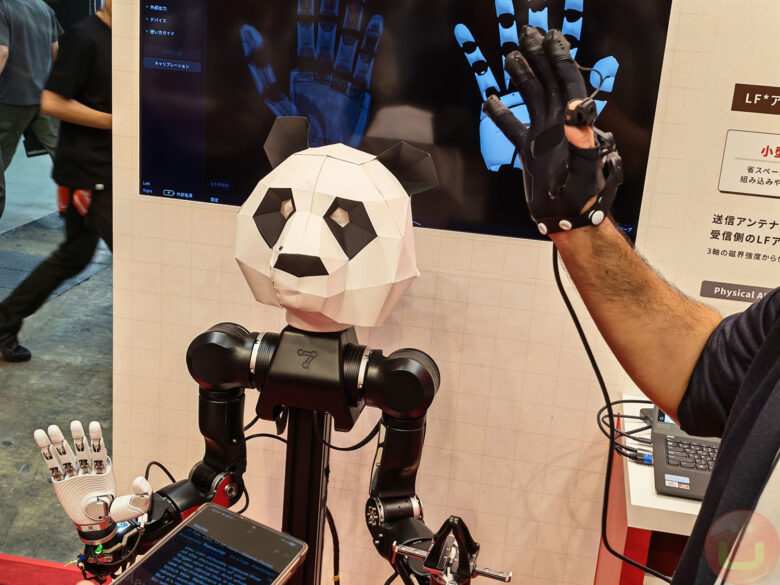
As the demonstrator moved his fingers while wearing the glove, his hand movements were reproduced in real time on a digital hand displayed on a nearby screen and by a physical robotic hand mounted on a robotic arm beside him. The demonstration illustrated how human gestures can be converted into digital data and used to control robotic systems.
Unlike camera-based systems, the glove uses electromagnetic-field (EMF) sensing to track finger movements without external cameras, avoiding problems caused by obstructed views or poor lighting.
Murata provides its proprietary miniature, high-sensitivity, three-axis low-frequency (LF) antennas, integrated into the glove’s fingertips. These components help MELT measure finger positions and orientations in three dimensions while maintaining a compact, energy-efficient design. According to Murata, its antenna technology delivers about three times the power efficiency of existing EMF-based gloves with the same battery capacity.
The glove employs MELT’s proprietary Zero-Drift Technology, which measures absolute finger positions rather than accumulating movement estimates over time, preventing tracking errors from building up during extended use. After an initial calibration, additional calibration is not normally required.
According to MELT, the glove tracks all five fingers, achieving a median positional error of 0.5 mm and a maximum error of 1.5 mm under specified conditions. It operates at 100 Hz, with latency of 30 milliseconds or less. The system measures finger positions and orientations across 30 degrees of freedom (6DoF per finger) and outputs 25 degrees of freedom through a biomechanical model.
What’s New in the ContactGlove3 Pro?
Kazami told us that the latest model launched about a month before CEATEC 2026 and offers improved tracking accuracy.
Compared with the standard ContactGlove3, the Pro version moves its tracking sensors from the second finger joints to the fingertips, enabling more precise measurements of delicate finger movements. This is particularly useful for capturing actions such as pinching small objects, grasping tools, and performing precise assembly tasks.
Kazami also highlighted a significant technical challenge: nearby metal objects can interfere with electromagnetic tracking, particularly in industrial environments.
MELT has developed noise-reduction technology that, according to Kazami, can reduce electromagnetic interference by up to 80%. He also emphasized competitive pricing, although he did not provide a specific comparison during our interview.
The glove includes software and an SDK supporting ROS 2, C++, Python, Unity, Unreal Engine, and MotionBuilder, making it easier to integrate into robotic systems, motion-capture workflows, and research applications. Battery life reaches up to 10 hours, and MELT lists the Pro model at $3,999 in the United States, with availability planned for November 2026.
Beyond live demonstrations, the objective is to build datasets of human movements that robots can learn from. Such data could help preserve skilled workers’ techniques and teach robots complex manipulation tasks that are difficult to program manually.

The robotic hand cannot bend its palm, unlike its human counterpart.
However, capturing human dexterity does not mean today’s robotic hands can reproduce every gesture, as Kazami explained during our discussion. Robotic hands still have mechanical limitations compared with their human counterparts. For instance, the robotic hand demonstrated at the booth could not bend its palm, unlike its human counterpart.
Murata and MELT announced their business alliance in September 2026, with plans extending beyond hand tracking to other human-machine interfaces, including a voice-input device using Murata’s piezoelectric technology.
Visit Murata Booth at CEATEC 2026
Visitors can see the ContactGlove3 Pro demonstration at Murata Manufacturing’s booth #7H340 in Hall 7, at Makuhari Messe. CEATEC 2026 runs from October 13 to 16.
Other Technologies on Display
Murata is also showcasing battery-free RFID sensor tags that detect strain and temperature changes in real time, along with glass-tube sensor tags designed to identify potential anomalies in infrastructure such as concrete structures. These technologies could help simplify inspections and maintenance without requiring batteries inside every sensor.
Another experimental wearable uses a microneedle patch to detect trace biological substances and convert chemical reactions into electrical signals, with potential applications in future health-monitoring systems.
In an unusual energy-harvesting demonstration, Murata uses beef fat as fuel. An enzyme breaks down the fat to produce glycerol, generating enough electrical power to illuminate an LED.
Visitors can learn more about these technologies in Murata’s official CEATEC 2026 exhibition information.
Together, these exhibits demonstrate Murata’s work across sensing, energy harvesting, and human-machine interfaces.
Murata and MELT Showcase Award-Winning ContactGlove3 Pro For Robotic Hand Training
, original content from Ubergizmo. Read our Copyrights and terms of use.