
What happens when a company creates an entire business division staffed by AI agents? NEC is exploring that idea with its Corporate AI & Workforce Division, where agents handle demanding analytical work, manage other agents, and report to human executives. The goal is to offload some of the cognitive heavy lifting while people concentrate on strategy, creativity, and final decisions. NEC established the division on August 1 and is showcasing the initiative at CEATEC 2026.
We spoke with NEC representatives at the show and found the move bold. Enterprises already use AI in many forms, but organizing agents into a formal division with managers, executive functions, and human oversight, represents an unexpected corporate commitment.
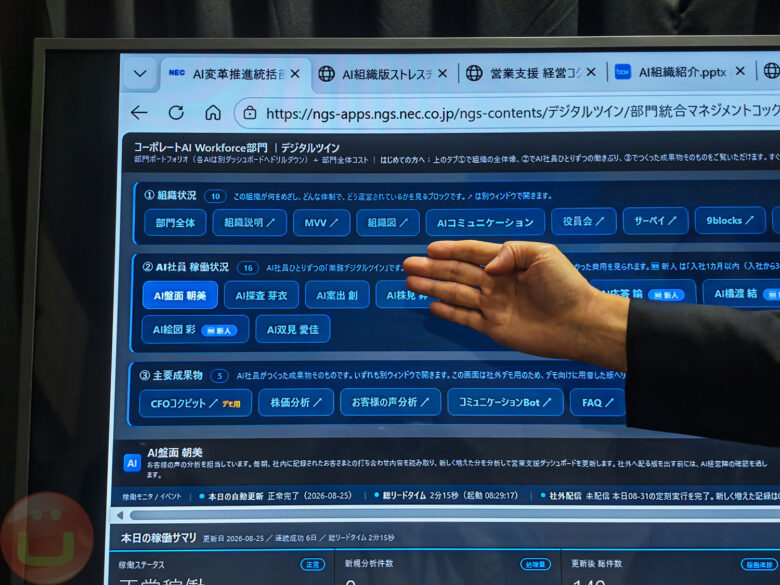
The division has four layers: an AI division head, an AI board, AI managers, and AI employees. Humans retain final responsibility for decisions, quality, and governance.
A familiar example is financial and business reporting. NEC’s official documentation describes an AI employee that analyzes management data, prepares reports, and incorporates them into a dashboard used by human executives. The dashboard also uses AI to identify subtle changes and emerging signals that people might overlook.
Another relatable function is checking other employees’ work. AI managers review agents’ outputs, monitor costs, and identify improvements. We understood that agents also conduct one-on-one meetings to examine failed tasks and propose corrective steps.
Our discussion at the show revealed an unexpected detail: NEC applies HR practices to its AI workforce. What caught out attention were the onboarding, engagement surveys, and “stress checks.”
The reported difficulties sound surprisingly familiar: vague instructions, missing permissions, inadequate support, and waiting for humans to approve something. In this context, “stress” describes responses used to identify obstacles to completing work; it does not establish that agents experience human emotions. NEC uses the feedback to improve their operating environment.
Token budgets introduce another practical constraint. Each model interaction consumes resources, so an agent organization needs to manage spending alongside output quality. NEC officially confirms that its AI managers track token usage. Obviously, we’re certain that that NEC makes (or will) efforts to reduce unnecessary consumption through model selection, caching, and better context. We did not discuss specific models or token figures during our CEATEC conversation.

The benefits NEC reports are broadly what we would expect: faster analytical work and more time for humans to tackle higher-level tasks. The company says its trial reduced the time needed for management analysis, simulations, and early risk detection to approximately one-seventh of the previous duration (for the tested workflow, not company-wide).
Turning an AI organization into an operating business division is a bold step.
It also raises an intriguing question… if AI agents have job descriptions, managers, performance reviews, and an HR function, should they count toward a company’s overall employee number?
NEC Gives AI Employees Their Own Division, Complete With HR and Stress Checks
, original content from Ubergizmo. Read our Copyrights and terms of use.