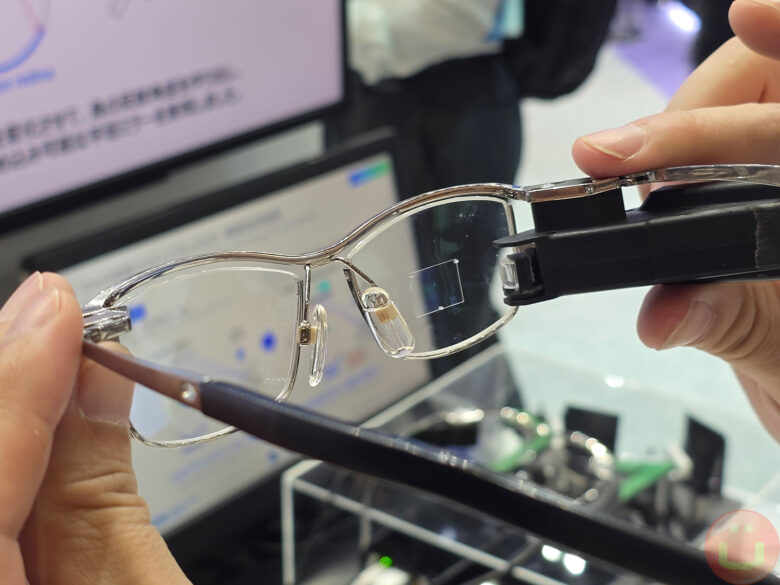
At CEATEC 2026 in Japan, I experienced TDK’s latest and most refined prototype of its direct retinal projection (DRP) smart glasses, featuring an impressively thin and transparent meta-optic mirror embedded in an eyeglass lens.
Unveiled on October 2, 2026, and touted by TDK as the world’s first direct retinal projection display for smart glasses using a meta-optic mirror, this technology takes a radically different approach to displaying images in augmented reality (AR) glasses.

Instead of using bulkier optical waveguides to create a virtual image that appears to float in front of the wearer, TDK developed a compact laser engine and a tiny transparent mirror to project images directly onto the retina. By removing the conventional waveguide, this innovation will make future display smart glasses significantly thinner and lighter.
Having seen earlier prototypes at CEATEC 2024, CEATEC 2025, and CES 2026, I have been following TDK’s progress closely. The latest demonstration represents an important step toward next-gen smart glasses that could become indistinguishable from regular prescription glasses.
TDK’s innovation received the Minister of Economy, Trade and Industry (METI) Award at CEATEC 2026, one of the exhibition’s highest distinctions, recognizing its potential to transform next-generation wearable displays.
A Tiny Transparent Mirror Replaces Conventional Waveguides
TDK’s breakthrough combines its proprietary meta-optic mirror, only 150 nanometers thick (about 1/667 the thickness of a human hair), with a compact laser projection engine. The nearly invisible mirror sits near the center of an eyeglass lens and lets about 80% of visible light pass through.
Unlike conventional AR glasses, which use bulkier optical waveguides to create a virtual image in front of the wearer, TDK’s Direct Retinal Projection (DRP) technology projects images directly onto the retina, largely bypassing the eye’s normal focusing requirements.
Retinal projection is not new, but previous systems required relatively bulky curved mirrors to direct laser light into the eye. TDK replaces them with a flat meta-optic mirror whose nanoscale structures precisely redirect light, even at negative reflection angles that conventional mirrors cannot achieve.
Another major benefit is that the projected image remains in focus regardless of the wearer’s normal vision correction needs. This could remove the need for additional prescription optics to view digital content, while prescription lenses would still correct the wearer’s everyday vision. TDK and QD Laser explain this capability in their September 2026 research paper, Direct Retinal Projection by Meta-Optic Mirror for Smart Glasses.

The result is a much simpler optical system that could turn any next-generation prescription glasses into display smart glasses, when future laser engines are small enough.
The technology also eliminates the rainbow-like interference patterns sometimes seen with waveguide displays and improves privacy, as people facing the wearer cannot see the projected images.
TDK claims the mirror can be manufactured using semiconductor wafer processes, potentially reducing production costs.
From Monochrome to Full-Color 4K Retinal Projection
The prototype demonstrated at CEATEC 2026 displays monochrome images, but TDK already has key technologies for the next step.
These include its Full-Color Laser Module (FCLM), which TDK touts as one of the world’s smallest, and a visible-light, full-color laser control device capable of achieving 4K resolution. These are separate technologies that have not yet been demonstrated together in the CEATEC prototype.
TDK is also working with QD Laser, a retinal projection specialist, to develop next-generation RGB laser light sources and optical engines, with full-color demonstrations and mass production planned in the coming years.
TDK AIsight: Bringing Everything Together for Everyday Smart Glasses
At CES 2026, TDK announced TDK AIsight, introducing an ultra-low-power processor and AI-driven eye-tracking technology designed for next-generation smart glasses. Its SED0112 processor analyzes eye movements and user intent while minimizing power consumption, an important requirement for small, battery-powered eyewear.
With the new meta-optic mirror, TDK’s broader smart glasses strategy is coming together. Direct retinal projection requires precise alignment between the projected image and the user’s eye, making eye tracking particularly relevant. TDK’s AIsight technology could help provide that capability while enabling context-aware AI features.
Low power consumption is another important part of the equation. Direct retinal projection could enable an energy-efficient display, while TDK’s AIsight processor is designed to minimize the power required for eye tracking and AI processing. Together, these technologies could help manufacturers build self-contained smart glasses with batteries integrated into the frame, rather than relying on an external battery puck connected by a cable.
Combined with the company’s compact laser projection technology, these innovations could bring high-resolution displays, intelligent sensing, and AI assistance into lightweight smart glasses that look and feel like everyday eyewear, rather than bulky technology worn on the face.
After watching TDK’s prototypes evolve from CEATEC 2024 to CES 2026 and now CEATEC 2026, the vision is clear: make smart glasses look so ordinary that the technology becomes nearly invisible—the ultimate dream of wearable tech innovators.
TDK is demonstrating its new meta-optic mirror technology at CEATEC 2026, Hall 5, Booth 5H261, October 13–16, at Makuhari Messe in Japan.
TDK Unveils Tiny Meta-Optic Mirror, Making Display Smart Glasses Ultra-Light
, original content from Ubergizmo. Read our Copyrights and terms of use.